
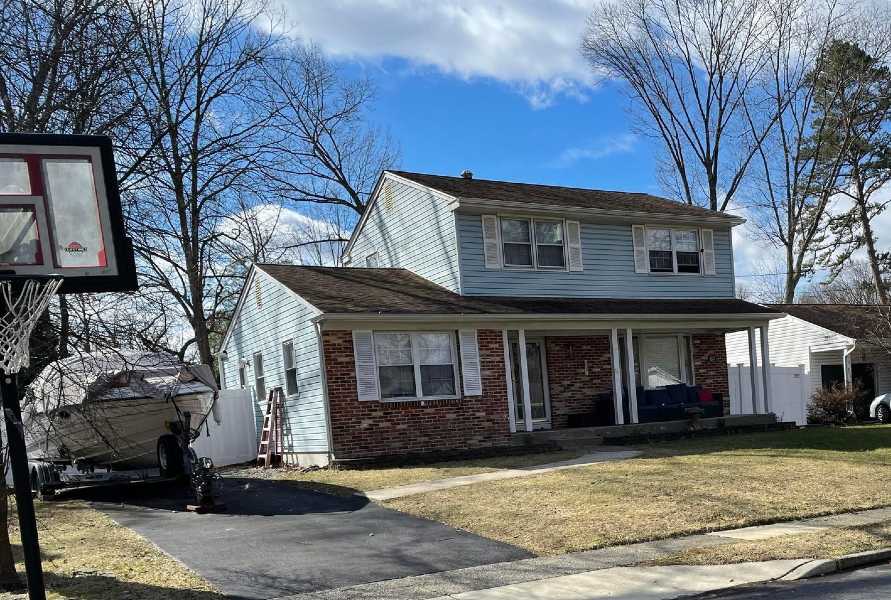
 There are always surprises when you buy a new house. But, imagine one of them being no heating or cooling on the second floor!
That’s the problem our Blackwood, NJ homeowners faced after just a few months in their new home. A contractor who renovated the kitchen years before our new homeowners bought the house cut out a return duct leading to the second floor.
Problem: A previous contractor cut out a return duct during a renovation in this suburban split-level home. As a result, the upstairs got almost no heating or cooling whatsoever.
Solution: Installed a three-zone mini split heat and cool the entire home without redoing the ductwork. Now, there’s better comfort and more customization in each part of the house.
That meant almost no air could flow from that part of the house down to the furnace. The heating and cooling worked just fine on the first floor. But, without circulation upstairs, the bedrooms might as well not have any vents at all.
There are always surprises when you buy a new house. But, imagine one of them being no heating or cooling on the second floor!
That’s the problem our Blackwood, NJ homeowners faced after just a few months in their new home. A contractor who renovated the kitchen years before our new homeowners bought the house cut out a return duct leading to the second floor.
Problem: A previous contractor cut out a return duct during a renovation in this suburban split-level home. As a result, the upstairs got almost no heating or cooling whatsoever.
Solution: Installed a three-zone mini split heat and cool the entire home without redoing the ductwork. Now, there’s better comfort and more customization in each part of the house.
That meant almost no air could flow from that part of the house down to the furnace. The heating and cooling worked just fine on the first floor. But, without circulation upstairs, the bedrooms might as well not have any vents at all.
 Our homeowners bought a few plug-in air conditioners — “window rattlers” as they called them — when the summer hit. But, by the end of the season, they knew they’d need a better solution for the winter.
But, what would it be?
Rerouting the ductwork would be expensive and require a lot of construction. The house wouldn’t look the same as when they bought it just a few months prior.
And, they’d spend all that money just to get “regular” heating and cooling again. You know, the type where your bedroom is still too hot in the summer and too cold in the winter.
So, they took a different route. Instead of reconstructing their old ducted system, our homeowners opted for a three-zone ductless mini split for their split-level home.
Installation would be fast and easy, and they’d get better comfort than they ever would have with traditional forced-air heating and cooling. In this case study, we’ll look explore:
Our homeowners bought a few plug-in air conditioners — “window rattlers” as they called them — when the summer hit. But, by the end of the season, they knew they’d need a better solution for the winter.
But, what would it be?
Rerouting the ductwork would be expensive and require a lot of construction. The house wouldn’t look the same as when they bought it just a few months prior.
And, they’d spend all that money just to get “regular” heating and cooling again. You know, the type where your bedroom is still too hot in the summer and too cold in the winter.
So, they took a different route. Instead of reconstructing their old ducted system, our homeowners opted for a three-zone ductless mini split for their split-level home.
Installation would be fast and easy, and they’d get better comfort than they ever would have with traditional forced-air heating and cooling. In this case study, we’ll look explore:
- How Ductless Works
- Replacing Ductwork And Vents With A Mini Split
- More Benefits Of Mini Split Heating And Cooling
- Ductless Mini Split Installation In Blackwood, NJ
How Ductless Works
As the name implies, ductless mini splits don’t require ductwork to heat and cool your home. That was the big selling point for our Blackwood, NJ homeowners. But how does it work exactly? The answer lies in the other part of the name: “mini split.” These systems are “split” between indoor and outdoor units that don’t look as if they’re connected at all. Outside you have the heat pump, which is responsible for moving heat into your home in the winter and out of it in the summer. In that way, it works similar to the standard AC condenser units you see outside houses. Except, it also works in “reverse,” bringing warmth into the house in the winter. Inside, you’ll see air handlers in one or more rooms. Each one sucks in the air in the room, warms or cools it, and then recirculates it. That’s instead of sending the air to your furnace and central air in the basement, and then all the way back up. But, how do the two work together? Simple: Flexible piping with refrigerant liquid running in a closed loop between the indoor and outdoor units. Heat warms or cools the liquid and travels between the components through that line. Now, let’s see what that looks like in action for our new homeowners.Replacing Ductwork And Vents With A Mini Split
Of course, the advantage in this home was bypassing that broken ductwork. Instead of depending on the ducts to send air throughout the house, our installers ran lines through the walls to each air handler. Then, all anyone sees is the air handlers mounted on a few walls throughout the house. There’s no extra construction to run a new return to the second floor and then build a wall around it. After all, that’s why someone cut out that return in the first place: To make the first floor look nicer during a renovation. Adding ductwork and a new enclosure would ruin that. As a result, the second floor finally got all the heating and cooling it needed. It’s even better than our homeowners expected! Second floors are notoriously hard to heat and cool because a forced-air system loses pressure as air moves further from the furnace. So, the circulation is usually a little weaker upstairs than downstairs. But, that’s not a problem with a mini split: All the circulation occurs right in the room.More Benefits Of Mini Split Heating And Cooling
Along with solving the ductwork problems, our homeowners enjoy even more benefits with their new mini-split:- Customized Temperature In Every Room
- Quiet Operation
- Easy Control